Being AP english students, we all carry around this idea of perfectionism. Although some of us may be more extreme than others, we all strive to get the best grade we can, and when we don’t, there is the immense guilt that wells up inside of us that eats us away as we grumble about how hard AP classes are. Being a student is hard in the sense that you are constantly carrying these high expectations of yourself. They can come from your parents, fellow students, or just from inner desire. It is hard to reach these goals, as perfection is something that is never reached.
Anne Quindlen uses the analogy of a backpack to illustrate this struggle that we carry. As students, it is very relatable to us. We have carried backpacks our whole academic career. I know personally that backpacks can hurt immensely when you try to fit your entire locker into them. It’s the same when you try to fit your life into a perfect backpack and carry it around as you walk. It’s necessary to drop out some of the items from your backpack. If you don’t, life can’t be fulfilled as much as it should be.
Sunday, October 28, 2012

Sunday, October 21, 2012
Names-The Crucible
They are labels given at birth. Often times people share the same first name or last name or even both. Names determine how people are called. They dictate what you answer to. Your name is who you are.
Evidently, names are an important part of society and the town of Salem is not an exception. The value of a townperson’s name determines their character, status, and power. It is because of people’s names that there is even conflict at all in The Crucible. It all starts out with Elizabeth “blackening” Abigail’s name. As a result of her loss of power, Abigail tries to take the power of other people’s names to recover and grow her own. This all creates a domino effect of continuous accusations and false condemnations. This cycle only stops when somebody is strong enough to live up to their righteous name. The problem is that nobody realizes this until it is too late. The sinful infection has spread too far and branched out so broadly that going against the trend cannot destroy the root. The writing of people’s names in the devil’s book wasn’t actually real, but the intangible placement of false accusations on people is what really caused the real trouble in the town of Salem.
Often we can see this behavior in society. Unwanted names and bullying labels are placed upon people, hurting them and forcing them to continue the chain to save face. The behavior of the witch trials are not unusual, they are just exaggerated, probably for the better, as society today would not be able to realize the exact same troubles that they are struggling with.
Sunday, October 14, 2012
Admitting-The Crucible
Admitting your mistakes is one of the most difficult things to do. It is exposing yourself to ridicule and shame. It means that you are telling people to disregard your judgement, to put themselves above you. Admitting you are wrong surrenders all of your opinions and personal assertions.
John Proctor is by far one of the strongest characters in The Crucible. He has committed a pride-crippling sin of adultery that me most certainly regrets. Despite him knowing what revealing his secret will do to his name, he presents himself vulnerably before the court in efforts to reveal truth and save his friends. He puts his badge of integrity, the Proctor, on the line for his companions. In a sense, he sacrifices his life and future. Unfortunately, even with this heroic act, John Proctor is thwarted by the ravings of a power-thirsty adolescent girl. Another risk of admitting, is the possibility of absolute failure. In this case, the life of John Proctor was long lost. It was eaten away by the brutal hunger of greed and hysteria.
Admitting is always an issue early on in life. It is commonly seen in school, starting from as early as elementary school. Who vandalized the board? Who stole the teacher’s pencils? Who didn’t put their folder away? Each student is faced with a momentous decision as the dreaded statement unfurls from the teacher’s mouth: if nobody confesses, the whole class will be punished. Students are then faced to receive the infliction of “taking the blame”. Whether or not the student had actually done the punishable act, they must decide if their pride or the well-being of the class and their friends is best at stake. A cruel process that carries on through life and in John Proctor’s case, death.
Sunday, October 7, 2012
The Power of Lying - The Crucible
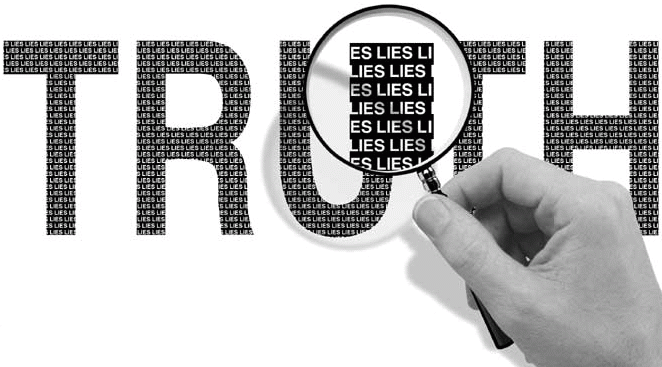
Lying has always been one of my strongest traits. It is a way to escape the most perilous social situations. It is a loophole to fix mistakes and an opportune chance for humor and deceit. It comes naturally and breaches the trust of the people around me. It strikes wittingly quick and is potently effective.
In The Crucible, the obvious ruler of liars is Abigail. She is probably one of the most manipulative characters in all of literature. From the beginning of the story she has been an engine of trickery that spews false speech nonstop. Her innocent child character and possibly her gender convinces nearly every townsperson in the exposition. While all of the adult figures are trapped in her lies, the children and lesser females are snared under her command. Majority of the young girls dutifully follow her lead and become her lying minions. Those who rebel against her are accused and then are forced to once again fall under her authority for their own survival. With the power of cleverly timed and worded lying, Abigail has gained complete supreme control over the town. In just a few days time she has gone from the rank of a common preacher’s daughter, to the judging executioner with the lives of every person within the palm of her seemingly clean hand.
Since the beginning of mankind, lying has been a form of power, as shown in the story of the serpent and Eve. From a simple convincing lie, the devil had managed to gain control of the whole human race yet to come. Since then, lying is still being used as the main cause for strife and calamity. Lying holds power. A power that lies within each and every one of us.
Subscribe to:
Posts (Atom)